

Key Definition
At its core, Islamic finance is a system of financial activity designed to comply with the Islamic law. It is built around principles such as the prohibition of interest or usury (riba), the avoidance of excessive uncertainty known as gharar, and the prohibition of gambling or pure speculation known as maysir.
Islamic finance is often introduced through, and solely linked to, the prohibition of interest. However, Islamic finance is not merely the removal of interest from a conventional loan. It represents a different moral architecture for money.
Islamic finance should not be understood only by what it prohibits. The World Bank describes Islamic finance as equity-based, asset-backed, ethical, sustainable, and socially responsible, emphasizing risk-sharing, financial inclusion, and a link between finance and the real economy.
In this guide, we take a concise look at what Islamic finance is and how it works.
The Problem Islamic Finance is Trying to Solve
The Islamic critique of interest-based finance is not simply that interest is “too expensive” or that lenders can be greedy. The deeper concern is that interest can separate reward from risk.
In an interest-bearing loan, the lender is contractually entitled to a return regardless of whether the borrower succeeds or fails. The borrower carries the commercial risk; the lender receives a fixed gain. Islamic finance views this as morally and economically problematic when it becomes the foundation of financial life. Wealth begins to generate wealth through debt itself, rather than through shared enterprise, trade, production, or asset ownership.
This does not mean that Islam rejects profit; on the contrary, Islamic commercial law recognizes trade as a central part of economic life and considers profit legitimate when it is earned through a valid sale, partnership, lease, service, or investment. What Islamic finance challenges is the idea that money, by itself, should earn a guaranteed increase merely because time has passed.
This is why Islamic finance replaces the logic of lending with the logic of contracts. Instead of asking, “How much interest will be charged on this loan?” it asks:
- “What is the underlying transaction?”
- Is there a sale? A lease? A partnership? An agency arrangement? A real asset? A shared business risk? A clearly defined responsibility between parties?
How Islamic Finance Works in Practice
Modern Islamic finance operates through contracts that are designed to meet financial needs while remaining Shariah-compliant. These contracts are not random inventions. They come from Islamic commercial jurisprudence and are adapted into modern banking, home finance, trade finance, project finance, insurance, and capital markets.
The most common structures include murabaha, ijarah, musharakah, mudarabah, sukuk, and takaful.
a) Murabaha – Cost-Plus Sale
A murabaha transaction is often used for asset financing.
Instead of giving a customer an interest-bearing loan to buy an asset, the Islamic bank purchases the asset and sells it to the customer at a disclosed markup. The customer then pays the price over time.
The profit is not framed as interest on money lent. It is profit from a sale.
For example, if a business needs equipment, the bank may buy the equipment and resell it to the business for a higher fixed price payable in installments.
For the structure to be meaningful, the sale should be real. The asset, price, markup, delivery terms, and payment schedule should be clear.
b) Ijarah or Lease-Based Financing
An ijarah is a lease.
The bank or financier owns an asset and leases it to the customer. The customer pays rent for using that asset.
This structure can be used for equipment, vehicles, property, and infrastructure. The return comes from usufruct, meaning the right to use an asset, rather than interest on a loan.
In a proper ijarah structure, ownership responsibilities and usage responsibilities should be clearly separated. The financier’s return is tied to the leased asset, not merely to the passage of time on borrowed money.
c) Musharakah or Partnership Financing
A musharakah is by definition a partnership. In this, two or more parties contribute capital to a venture and share profits according to an agreed ratio. Losses are generally shared according to capital contribution.
A common modern version is diminishing musharakah, often used in home financing. In this model, the bank and customer jointly own a property. The customer gradually buys out the bank’s share while paying rent for the portion still owned by the bank.
This model reflects one of the central ideas in Islamic finance: reward should be connected to ownership, responsibility, and risk.
d) Mudarabah: Investment Partnership
A mudarabah is an investment partnership in which one party provides capital and the other provides expertise or management.
Profits are shared according to a pre-agreed ratio. Financial losses are borne by the capital provider unless the manager is negligent, commits misconduct, or breaches the agreement.
This structure shows that Islamic finance is not anti-investment. It is deeply investment-oriented. It simply wants investment returns to arise from risk-bearing and productive activity, not guaranteed interest.
Mudarabah can be used in investment accounts, funds, business finance, and other partnership-based arrangements.
e) Sukuk or Asset-Linked Islamic Securities
Sukuk are often described as Islamic bonds, but that comparison can be misleading.A conventional bond represents debt. The issuer borrows money and promises repayment with interest.
Sukuk are intended to represent ownership or beneficial interest in assets, usufructs, services, or investment activities. Investors earn returns linked to the performance or use of the underlying asset or venture.
In practice, sukuk structures vary. Some are closer to genuine asset ownership, while others can resemble conventional bonds more closely than critics would like. Still, the ideal is different: investors should earn returns through a Shariah-compliant asset or activity, not interest on debt.
f) Takaful: Cooperative Risk Protection
Takaful is the Islamic alternative to conventional insurance. Instead of a pure risk-transfer model where policyholders pay premiums to an insurance company, takaful is generally structured around mutual cooperation. Participants contribute to a pool that is used to support members who suffer covered losses.
The principle behind takaful is shared responsibility. Participants help one another manage risk rather than simply transferring risk to a conventional insurer.
Islamic Finance is Not Just “Halal Banking”
One mistake people make is treating Islamic finance like conventional finance with Arabic contract names. That is not enough.
For Islamic finance to work properly, the substance must match the structure. If a product claims to be based on a sale, lease, partnership, or asset, that claim should be real in the contract and execution.
| Misunderstanding | What Islamic Finance Requires |
| Islamic finance only means removing interest. | The transaction should be built on a valid sale, lease, partnership, agency, or investment structure. |
| Arabic terms make a product Shariah-compliant. | The actual contract, ownership, risk, and cash flows must match the Islamic structure being used. |
| A fixed return is always acceptable if called profit. | Profit should come from trade, leasing, ownership, service, or shared investment risk, not disguised interest. |
| Shariah compliance is only about intention. | Documentation, execution, governance, and real transaction substance all matter. |
| Islamic finance has no risk. | It still carries risks, but those risks should be allocated more transparently and ethically. |
This is why Shariah governance matters. Islamic financial institutions often rely on Shariah boards, scholars, auditors, and standards to review whether products match Islamic commercial principles in both form and substance.
AAOIFI, for example, prepares accounting, auditing, governance, ethics, and Shariah standards for Islamic financial institutions and the wider industry.
Islamic Finance in Practice: A Real-Life Example
Consider a small business that needs a delivery van:
In a conventional loan, the business may borrow money from a bank, buy the van, and repay the loan with interest. The bank’s return is linked to the loan contract. Whether the van helps the business succeed or not, the interest obligation remains.
In an Islamic murabaha structure, the bank may buy the van first and then sell it to the business at a disclosed markup. The business pays the agreed sale price in installments.
In an ijarah structure, the bank may own the van and lease it to the business. The business pays rent for using the van.
In a musharakah-style arrangement, the bank and business could share ownership in an asset or project, with profits and risks allocated according to the agreement.
The practical result may look similar from the outside: the business gets access to an asset and pays over time. But the legal logic is different. The transaction is not built on interest charged on money. It is built on sale, lease, ownership, or partnership.
Why Islamic Finance Has Grown Globally
Islamic finance is no longer a niche system used only in a few Muslim-majority countries. It has become a major part of global finance.
The Islamic Financial Services Board reported that global Islamic financial services industry assets reached approximately USD 4.4 trillion in 2025.
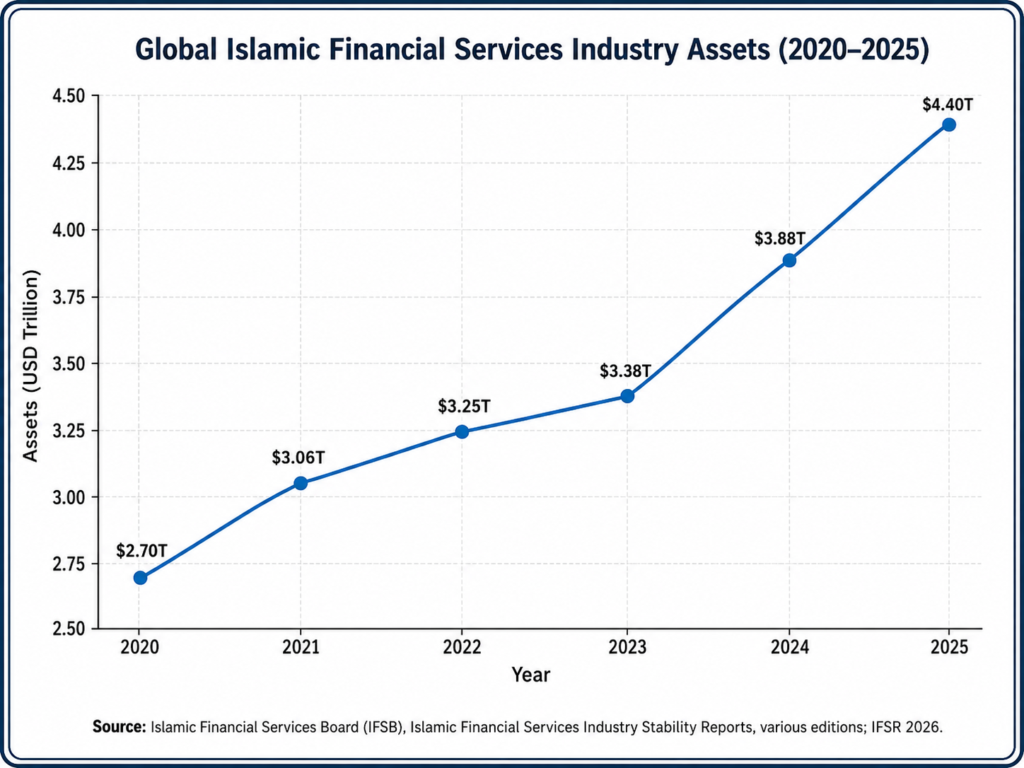
Source: Islamic Financial Services Board, Islamic Financial Services Industry Stability Reports 2022-2026.
Global Islamic financial services industry assets increased from approximately USD 2.70 trillion in 2020 to approximately USD 4.40 trillion in 2025.
This growth is not only religious. Muslim consumers and businesses naturally want financial products aligned with their beliefs, but Islamic finance also fits into a wider ethical finance conversation.
Its principles connect finance to real assets, discourage excessive speculation, and encourage a closer relationship between risk and reward. That does not make Islamic finance immune to financial problems, but it does explain why the model continues to attract attention from banks, investors, regulators, and ethical finance advocates.
Common Misunderstandings About Islamic Finance
1. Islamic finance is not anti-profit
Islamic finance does not reject profit. It rejects riba, excessive uncertainty, gambling, and transactions that detach reward from legitimate trade, ownership, service, or risk.
Profit from a valid sale, lease, partnership, or investment is part of Islamic commercial life.
2. Islamic finance is not charity
Islamic finance has ethical foundations, but it is not the same as charity. Banks, investors, and businesses can earn returns.
The difference is that returns should come from Shariah-compliant contracts and real economic activity.
3. Islamic finance is not risk-free
Risk does not disappear. It is allocated differently.
A murabaha transaction has credit risk. An ijarah has asset and lease risk. A mudarabah has business risk. A sukuk has structural and market risk.
Islamic finance aims to connect risk with responsibility, not eliminate risk altogether.
4. Islamic finance is not only for Muslims
Islamic finance is rooted in Islamic law, but its principles can appeal to anyone interested in ethical finance, asset-backed activity, risk-sharing, and limits on speculation.
Many Islamic financial products serve Muslim customers, but the broader ideas can also speak to non-Muslim investors and institutions.
Summary
Islamic finance is a Shariah-compliant financial system built around the prohibition of riba, excessive uncertainty, and gambling or pure speculation.
At its best, Islamic finance is not simply conventional finance with Islamic terminology. Its credibility depends on whether the contract, documentation, ownership, risk, and governance reflect the principles it claims to follow.

Azmi Anees is a certification and compliance specialist working with the American Halal Foundation, where he focuses on global halal certification programs, integrated audits, and market-access strategy for food, cosmetic, nutraceutical, and ingredient manufacturers. He has worked closely with multinational brands and SMEs across North America, the Middle East, and Southeast Asia. His insights emphasize on practical guidance for manufacturers looking to achieve halal compliance while improving operational efficiency and global market reach.



 Food
Food Bread & Bakeries
 Beverages
 Coffee
 Confectionery Products
 Dairy & Cheese
 Food Service
 Food Enzymes
 Meat and Poultry
 Natural & Artificial Food Flavors
 Nuts & Dried Fruits