
Featured AHF Certified Manufacturer – Feed My Starving
Feed My Starving Children (FMSC) is a proud AHF halal certified organization and a global leader in humanitarian nutrition, delivering scientifically formulated, culturally adaptable meals to vulnerable communities around the world, now made even more inclusive and impactful through halal certification.
About the Company
Feed My Starving Children (FMSC) is a nonprofit organization dedicated to addressing hunger and malnutrition across the globe. Through its signature MannaPack® meal formulas, FMSC provides nutritionally complete, shelf-stable meals carefully developed by food science and nutrition professionals.
Feed My Starving Children began in 1987 in Minnesota, USA, when a businessman felt a powerful calling to address the growing crisis of world hunger. Working alongside nutritionists, food scientists, and humanitarian organizations, the team developed the first specially formulated meals designed to meet the nutritional needs of malnourished communities.
From those humble beginnings, FMSC has grown into a global movement. More than 4 billion meals have been hand-packed by millions of volunteers and delivered to over 100 countries, feeding children and families in some of the world’s most vulnerable regions.
Why Does Halal Certification Matter for FMSC ?
With over 2 billion Muslims worldwide, FMSC recognized the importance of making its meals accessible to all children, regardless of religion, culture, or dietary requirements. Achieving halal certification with AHF ensures that its MannaPack® meals meet Islamic dietary standards, enabling trusted distribution in Muslim-majority regions and strengthening the organization’s mission of inclusivity.
The AHF Partnership
Undergoing halal certification with the American Halal Foundation was transformative for FMSC. The process not only ensured compliance but also deepened the organization’s understanding of halal principles and Islamic dietary law.
AHF’s team guided FMSC with professionalism, clarity, and compassion, making the halal certification journey one of collaboration and shared purpose for the team.
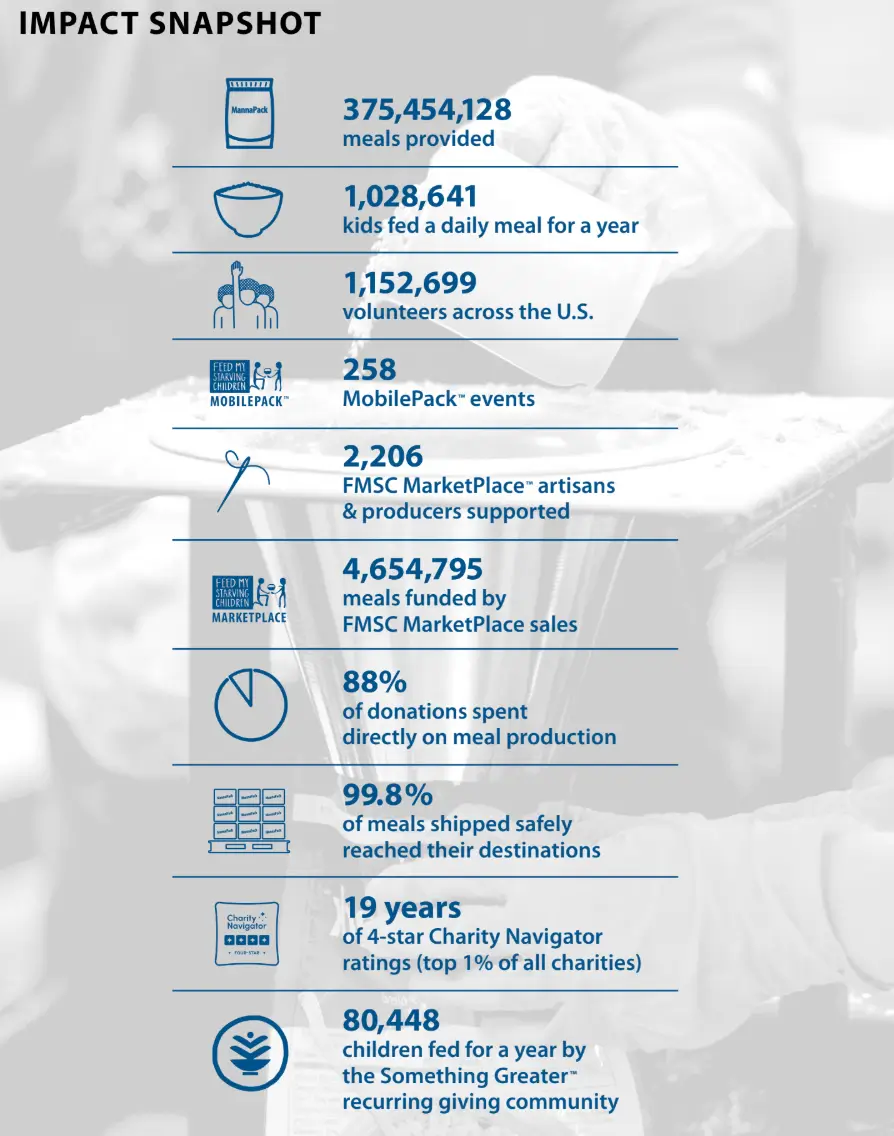
FMSC Impact Snapshot
Impact of Halal Certification
| Category | Details |
|---|---|
| Brand Impact | Halal certification reinforces FMSC’s commitment to global inclusivity, cultural sensitivity, and religious respect. It signals to partners and beneficiaries alike that FMSC meals are designed for everyone. |
| Global Reach | Certification has enabled FMSC’s meals to be distributed in Muslim-majority regions where halal compliance is essential, significantly broadening the scope of their humanitarian reach. |
| Partner Confidence | Humanitarian organizations now have greater confidence distributing FMSC meals in sensitive regions, knowing they meet both nutritional and religious standards. |
| Mission Expansion | Halal certification has strengthened existing partnerships and opened doors to new collaborations, allowing FMSC to feed more children globally and fulfill its mission more effectively. |
“Feed My Starving Children isn’t just feeding bodies — it’s feeding futures. And halal certification is helping make that future possible for millions more.”
Halal in numbers
Trillion +
Global Halal F&B Market
X
Halal is more than fifty-seven times larger than kosher
%
of the global population adheres to halal
Halal is the #1 influence on halal consumers' purchasing decisions.
AHF will process your halal certification application free-of-cost
Halal certification explained in 3-minutes
1 |
Application
|
| The American Halal Foundation (AHF) will process your application. Your designated Certification Manager will guide you through the application process to determine the halal status of the facility and its products. | |
 5-7 Business Days
2 |
Audit
|
| Your Certification Manager will schedule a halal audit on a mutually convenient day. The audit typically lasts 4 hours and includes a training session for employees who will be responsible for overseeing the halal production. | |
3 |
Halal Certification
|
|
🎉 Congratulations Upon the successful completion of the halal audit, your products and facility are now officially halal certified and recognized as such internationally. You may add products or facilities at any time by simply contacting your Account Executive. |
|
FAQ
What is halal certification?
Halal certification is an independent assessment and determination of a product’s compliance with the international halal standards adhered to by 2 billion consumers globally. To obtain halal certification: get in touch.
Who conducts halal certification?
Do all suppliers need to be halal certified to obtain halal certification?
Not all suppliers must be halal certified, but any ingredient of animal origin or with a high risk of contamination will need to come from a halal-certified source. For low-risk or plant-based materials, a declaration and detailed documentation may be sufficient. You can qualify your supply chain for halal here.
What is halal?
What is a broad guideline for assessing the qualification of a product as “halal”?
The halal philosophy can be understood in simple terms with the following acronym; “Everything is halal except ABCD IS haram.”
A- Alcohol (ethyl) and all types of intoxicants/drugs
B- Blood – flowing or congealed
C- Carnivorous animals
D- Dead meat – meat that is not slaughtered according to Islamic slaughtering rites
I- Food immolate unto idols
S- Swine and all swine derivatives
Does AHF have any application fees for the qualification of halal products?
What types of products can be halal certified?
Products eligible for the AHF halal certification include:
- Food and beverages
- Meat and poultry
- Cosmetics and personal care
- Nutraceuticals, pharmaceuticals and supplements
- Packaging and logistics
- Cleaning & sanitization products
How long does the halal certification process take?
Can I use one AHF halal certificate to export to multiple countries?
Yes, since AHF has a wide array of international accreditations, its halal certificate is widely accepted and sufficient for exporting to multiple countries.
Can companies transition their halal certification from another halal certification body to AHF?
Yes, the AHF transition program enables companies to transition their existing halal certificate to the American Halal Foundation (AHF). However, the existing halal certificate must come from a recognized halal certification body to qualify for the AHF transition program.
Does AHF offer integrated audits with other certifications?
Yes, AHF through its parent company offers integrated audits that combine halal certification with other programs such as HACCP, SQF, GMP, Vegan, and more. This streamlined approach reduces audit duplication and lowers costs—saving companies up to 30% in costs.
Are kosher-certified products also halal by default?
How do I obtain halal certification of my product that is manufactured under a private label with a third-party manufacturer?
How much does halal certification cost?
2. The Number of products
3. The complexity of products (from a halal standpoint)
4. Applicant classification (meat processor, private label brand, ingredient manufacturer, etc.)


Get in Touch
Connect with a halal certification expert.
Helpful Articles
The Role of Identity Preservation in Food Quality Certifications
In the context of food quality certifications like organic, halal, gluten-free, and non-GMO identity preservation (IP) has become a critical system for ensuring that certification claims remain credible. IP refers to maintaining the distinct identity of...
Guide to Halal Certification for Food Manufactures in the USA
Halal certification in the U.S. is no longer optional for brands that want to compete. It is the difference between staying local and tapping into a $226-billion North American market set to nearly double by 2033. Without it, you miss the trust of over 3.5...

10 Easy Halal Food Recipes to Try
It’s estimated that 1 in 4 people, globally, consume Halal food, therefore, if you’re an individual or a restaurant-owner, learning what makes food halal is gonna be important to you in the coming years. And even more crucially, learning some of the simple yet...
 Food
Food Bread & Bakeries
 Beverages
 Coffee
 Confectionery Products
 Dairy & Cheese
 Food Service
 Food Enzymes
 Meat and Poultry
 Natural & Artificial Food Flavors
 Nuts & Dried Fruits