
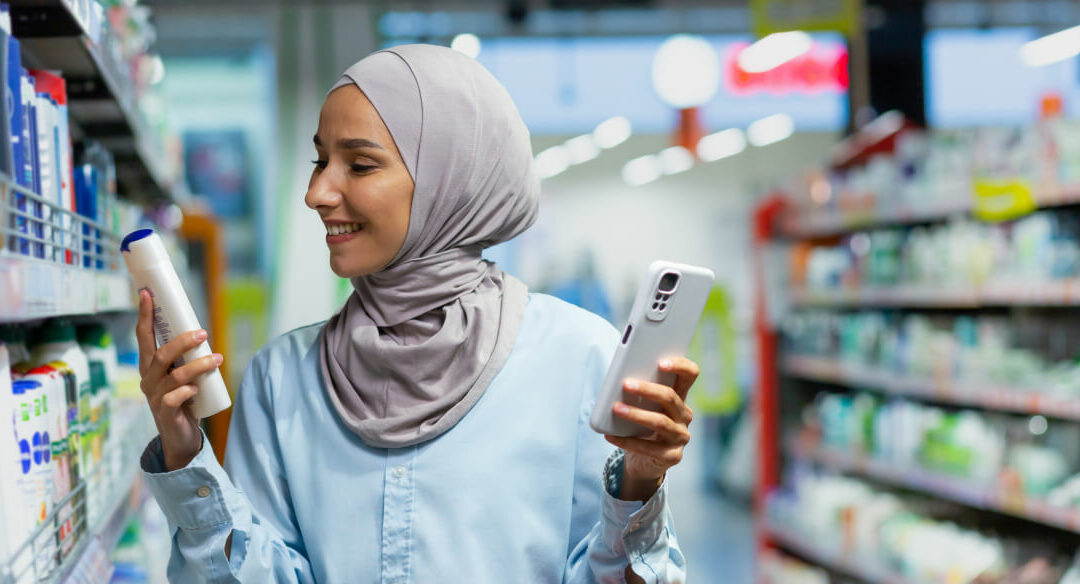
The global beauty market is expected to grow by 5 percent annually, reaching $590 billion by 2030. This constant growth has attracted an enormous wave of new brands, private label products, and direct-to-consumer launches. The shelves, both physical and digital, are full. Consumers are more informed, more sceptical, and more selective than at any point in history.
So how do brands capture their attention? In this guide, we dive into seven strategies that can help.
1. Third-Party Certifications
Independent third-party certifications tell a skeptical consumer that someone outside your marketing team verified your claims, and that changes purchasing behavior at scale.
Some certifications that carry weight right now are:
- GMP 22716 Certification: ISO 22716 is the internationally recognized Good Manufacturing Practices standard specifically developed for cosmetics. It covers key quality controls across production, control, storage, and shipment of cosmetic products. For brands, third-party certification against ISO 22716 can provide a strong trust signal to retailers, distributors, business partners, and consumers by demonstrating that manufacturing takes place under a structured and independently assessed quality system.
- Halal Certification. This is the largest opportunity most Western beauty brands are completely ignoring.The global halal cosmetics market size is projected to reach USD 143.02 billion by 2034. Halal-certified products are increasingly purchased by non-Muslim consumers too who associate the certification with clean, alcohol-free, ethically produced formulations.
- Vegan Certification. Vegan certifications remain among the most significant purchase influencers. Consumers who value products that do not involve animal testing or animal-derived ingredients, look for a verified credential from a recognized body.
- Gluten-Free Certification. For lip products, skincare, and anything applied near mucous membranes, gluten-free certification opens a consumer segment that actively searches for it, and finds almost no competition from brands willing to make the claim with verified backing.
2. Content Marketing
Millennials and Gen Z are driving demand for ingredient transparency, favouring online shopping and picking brands that give education and credible guidance.
This is where content marketing becomes genuinely powerful for cosmetics brands. What does that look like in practice?
- Explain each key ingredient: what it is, what it does, and critically, what it is not (no alcohol, no pork derivatives, no synthetic fragrance). This is especially powerful for halal and clean beauty audiences
- Walk your customer through what your halal or vegan certification actually requires. Which ingredients were reviewed? What had to change in your formulation? What body issued the certification, and what do they check?
- Video walkthroughs, quality control process explanations, and raw material sourcing stories build a credibility wall that paid advertising cannot replicate.
3. Micro-Influencer Marketing
Micro-influencers, creators with between 10,000 and 100,000 highly engaged followers in a defined niche, consistently outperform larger accounts on both engagement rate and purchase conversion. And for certification-led brands, the niche is the point.
Social media, online reviews, and previous experiences clearly influence buying decisions. For example, a Muslim beauty creator with 40,000 followers whose audience trusts her halal product recommendations is worth more to your brand than a celebrity partnership with millions of passive followers who never asked about halal certification in their lives.
4. Developing E-Commerce Experience
Your e-commerce experience needs to convert the person who landed on your product page with one hand on the back button.
For certification-led brands, every product page should include:
- Certification badges above the fold
- A clickable certification section explaining what each certification covers
- Full ingredient lists with plain-language notes on what is excluded, alcohol-free, pork-derivative-free, gluten-free where applicable
- Customer reviews that reference certifications, social proof from buyers who share your customer’s values.
5. Leveraging AI
Almost half of beauty shoppers are now getting product recommendations from generative AI, according to NIQ. That is a discovery channel with no ad inventory and no bidding, and most beauty brands have done nothing deliberate about it.
Assistants pull from what they can find and cite: editorial roundups, retailer listings, forum discussion, expert content, and structured pages on your own site. Getting cited is a content and PR problem more than a technical one.
Practical steps:
- Write the comparison content yourself. “X vs Y” and “best for [concern]” pages that include competitors honestly. If you will not write it, someone with an affiliate link will.
- Keep a factual, well-structured page for every product with specifications an assistant can lift: ingredients, concentrations, skin types, sizes, price, certifications.
- Pursue mentions in the sources assistants lean on. Editorial roundups, dermatologist-authored articles, and category reviews matter more than a follower count.
6. Structure Retention Around Consumption Cycles
Beauty products deplete on a predictable schedule. A serum is typically consumed within eight to twelve weeks, a cleanser in roughly six. Few consumer categories offer this degree of forecastability, and it should inform the retention program directly. In most brands it remains secondary to acquisition.
A consumption-based retention calendar addresses four areas.
- Replenishment timing: Email and SMS should be triggered against the depletion window of each SKU rather than a uniform thirty-day interval. Where usage data is unavailable, estimates derived from pack size and directed application rate provide a workable baseline.
- Routine sequencing: A customer purchasing a vitamin C serum has a corresponding requirement for daily sun protection. Communicating the basis for that pairing is product education, and is generally received as such.
- Expectation setting: A substantial share of skincare returns originate with customers who discontinue use at week three on a product with an eight-week efficacy profile. Stating the expected timeline at the point of purchase, and restating it during the post-purchase sequence, reduces that outcome.
- Subscription design: Subscription is appropriate where consumption genuinely repeats. Cancellation should be straightforward to complete. The reputational cost of cancellation friction typically exceeds the revenue it preserves.
Retention performance also governs acquisition economics. A higher repeat purchase rate raises the allowable cost per first order, which permits a brand to compete for paid placement at a higher bid without increasing total spend.
Frequently Asked Questions (FAQs)
Q1: What is the difference between self-declared claims and third-party certifications in cosmetics?
A self-declared claim, such as printing “halal” or “vegan” on your packaging without external verification, carries no independent accountability. A third-party certification means your product formulation, ingredients, and manufacturing process have been reviewed and approved by a recognized certifying body.
Q2: Why does it matter which manufacturer I use, and what should I look for?
A manufacturer that holds ISO 22716 GMP certification operates under internationally recognized guidelines covering raw material sourcing, production hygiene, batch traceability, equipment standards, and quality testing. This matters because your halal, vegan, and gluten-free certification claims are only as credible as the production environment behind them.
Q3. Is halal certification only relevant for Muslim consumers?
No. Halal certification increasingly resonates with a broader audience seeking clean, ethically produced, alcohol-free, and additive-free beauty products.
Q4. How do certifications actually improve my marketing results?
Values-driven consumers, whether motivated by religious compliance, clean beauty principles, or ingredient sensitivity, have a specific set of questions before they buy. Certifications answer those questions before the customer has to ask them.

Azmi Anees is a certification and compliance specialist working with the American Halal Foundation, where he focuses on global halal certification programs, integrated audits, and market-access strategy for food, cosmetic, nutraceutical, and ingredient manufacturers. He has worked closely with multinational brands and SMEs across North America, the Middle East, and Southeast Asia. His insights emphasize on practical guidance for manufacturers looking to achieve halal compliance while improving operational efficiency and global market reach.



 Food
Food Bread & Bakeries
 Beverages
 Coffee
 Confectionery Products
 Dairy & Cheese
 Food Service
 Food Enzymes
 Meat and Poultry
 Natural & Artificial Food Flavors
 Nuts & Dried Fruits