CareerNewsroomAbout UsContact
American Halal Foundation
Get Halal Certified
+1 (630) 759-4981Get Halal Certified
Home·Halal Checklist·Cross-Contamination Prevention Checklist

Comprehensive Halal Cross-Contamination Prevention Checklist

Purpose: This Comprehensive Halal Cross-Contamination Prevention Checklist is designed to help businesses conduct thorough internal audits to ensure compliance with halal standards. Use this checklist during regular audits to ensure all aspects of your operations comply with halal standards. Check each item as 'Compliant,' 'Non-Compliant,' or 'Not Applicable.' Provide detailed notes and recommendations for any non-compliant items.
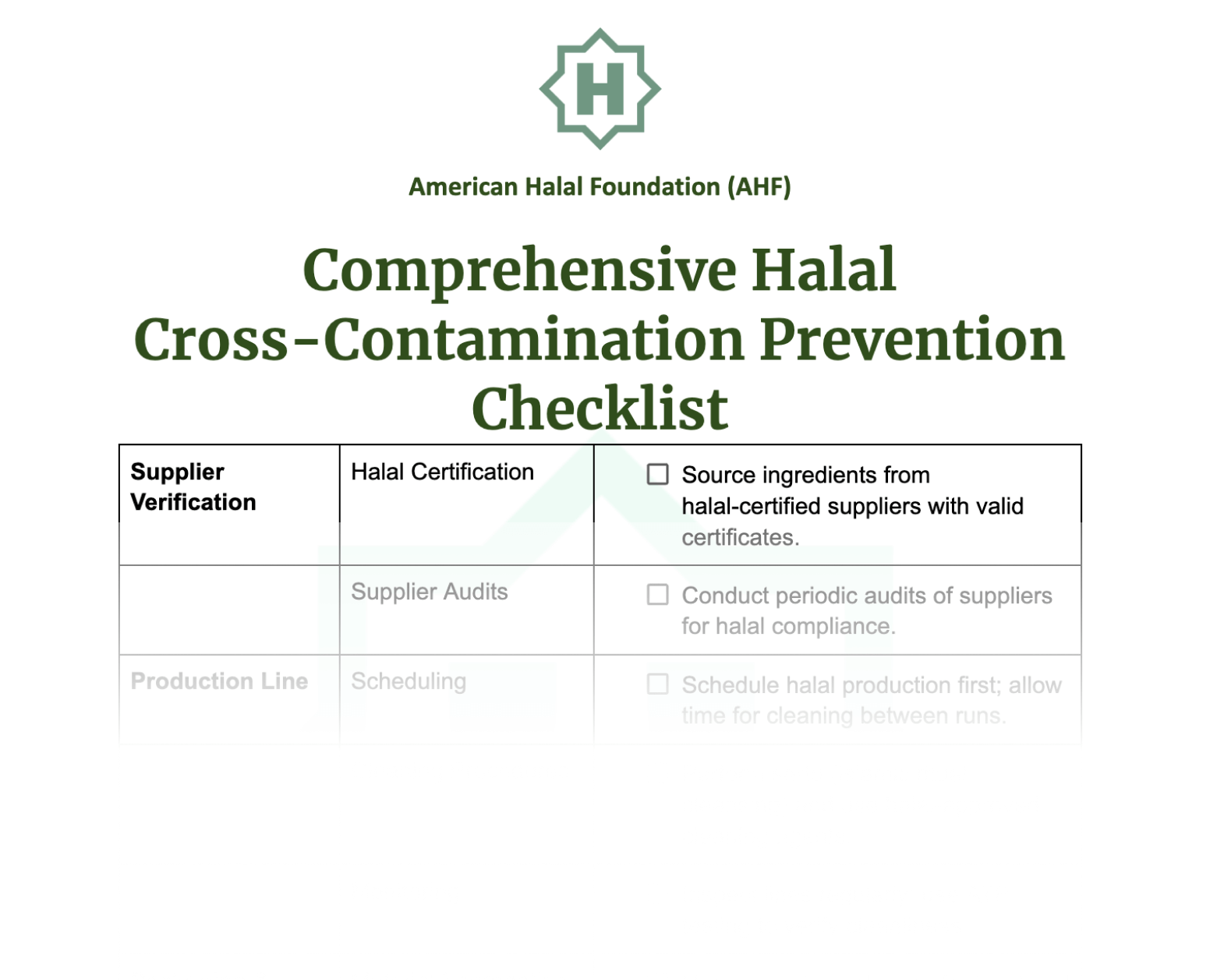
Comprehensive halal cross-contamination prevention checklist illustration
Comprehensive Halal Cross-Contamination Prevention Checklist

Download Comprehensive Halal Cross-Contamination Prevention Checklist

Enter your details to download the checklist. No sales call unless you ask.

Get the checklist

Other Checklists

Halal Cross Contamination Checklist
Halal Cross Contamination ChecklistView checklist
Halal Checklist for Foodservice/Catering Providers
Halal Checklist for Foodservice/Catering ProvidersView checklist
Halal Checklist & Requirements for Flexible Packaging
Halal Checklist & Requirements for Flexible PackagingView checklist
Internal Halal Audit Checklist
Internal Halal Audit ChecklistView checklist

Frequently Asked Questions (FAQs)

Non-halal ingredients in food products include animal or animal-derived substances from those not slaughtered according to halal standards (e.g., meat & poultry, gelatin, certain vitamins, or enzymes), alcohol used in production, pork derivatives, and any additives with hidden animal sources.
Halal certification limits alcohol use, allowing it only if it's from non-haram sources, used as a necessary solvent, and fully removed from the final product. Typically, alcohol content must be below 0.5% or absent to meet halal standards.
The certification process typically takes 4-8 weeks, depending on document readiness, the complexity of materials, and audit scheduling.
Required documents include completed application form, ingredient specifications, process flow diagrams, supplier halal certificates (if available), and facility layout. These details help assess halal evaluation and cross-contamination risks.
Halal-certified manufacturers must implement strict separation protocols, including dedicated production lines or thorough cleaning of shared equipment if any forbidden (haram ingredients). Regular internal audits and training on halal compliance are essential to prevent cross-contamination with non-halal substances.
Yes,halal certification bodies require that all relevant employees undergo training on halal standards. This includes understanding the importance of avoiding cross-contamination, proper handling of halal-sensitive products, and thorough documentation procedures.

The cost of halal certification depends on:

Number of Facilities and locations

Nature of Product

Number of Products

Are there any animal derivatives or ethanol involved?

Desired timeline for certification

Is the intended market domestic or international?

Get in Touch
+1 (630) 759-4981
info@halalfoundation.org
LinkedIn
United States
  • Atlanta
  • California
  • New York
  • Texas
  • Ohio
  • Virginia
  • Minnesota
  • Michigan
  • Missouri
  • Wisconsin
  • Utah
  • Show all states
Countries
  • Canada
  • Mexico
  • China
  • Japan
  • Colombia
  • Brazil
  • Chile
  • United Kingdom
  • European Union
  • India
  • Indonesia
  • Malaysia
  • Nigeria
  • South Africa
  • Australia
  • Spain
  • Italy
  • France
  • Netherlands
  • Korea
American Halal Foundation
Subscribe to our Newsletter

Stay ahead in a rapidly changing world.

Halal Certification
Get Certified
  • Apply for Certification
  • Get Halal Certified
  • Transition to AHF
  • Halal Training Program
How It Works
  • Process & Timeline
  • Requirements & Standards
  • FAQ
Specialty Certificates
Certificates
  • Halal Facility Certificate
  • Halal Product Certificate
  • Halal Export Certificate
  • Halal Batch Certificate
  • Private Label Certificate
Global Recognition
Accreditations
  • Indonesia – BPJPH
  • UAE – EIAC
  • Malaysia – JAKIM
  • Singapore – MUIS
  • Thailand – CICOT
  • Morocco – IMANOR
  • Qatar – MOPH
  • WHFC
  • Saudi Arabia – GAC
  • Saudi Arabia – SHC
  • See All
Corporate
  • About AHF
  • Why Choose AHF
  • AHF Halal Standards
  • Careers
  • WHFC Membership
  • A Brief History of AHF
Industries
Core Verticals
  • Food & Beverage
  • Chemicals
  • Cosmetics & Personal Care
  • Nutraceuticals & Supplements
  • Pharmaceuticals
  • Food Service
  • See All Industries
Resources
Learn
  • What is Halal?
  • Halal & Haram Ingredients
  • FAQ
  • Nutrition Label Generator
  • Halal Certification ROI Calculator
  • Halal Checklist
  • Halal Logo Use & Guidelines
Insight
  • Case Studies
  • AHF Insights
  • Halal Consumer Blog
  • AHF News
  • Press Releases
  • Webinar Registration
Legal & Compliance
Public Information
  • Complaint Form
  • Compliance & Public Information
  • Delisted Companies
  • Halal Suitability Statement
  • Recertification Form
  • Referral Rewards Program
International Halal Accreditation & Recognition
WHFCCICOTJAKIMBPJPHGCCEIACMUISMOPHIMANOR
Copyright © 1983 - 2026 American Halal Foundation (USA)
Terms And ConditionsPrivacy PolicyCookie Policies
Built by Woofocus