

As one of the world’s largest consumer markets and home to the largest Muslim population globally, Indonesia has become increasingly structured in how it regulates imported products, particularly in sectors such as food, beverages, cosmetics, supplements, pharmaceuticals, and other consumer goods.
This guide is designed to help U.S. companies understand the key registration requirements, the role of Indonesian authorities, and the practical steps needed to prepare products for successful market entry.
BPOM Registration and Halal Certification Are Separate
One of the most common mistakes exporters make is treating Indonesia’s product registration and halal certification as the same process.
They are connected, but they are not the same.
BPOM, Indonesia’s National Agency of Drug and Food Control, regulates many processed foods, beverages, cosmetics, medicines, health supplements, and related products. BPJPH, the Halal Product Assurance Organizing Agency, regulates halal certification and recognition.
A product may need both:
- Product registration or notification through BPOM or another technical authority
- Halal certification or foreign halal certificate registration through BPJPH/SIHALAL
- Import clearance before shipment
- Correct Indonesian labeling before distribution
For exporters, the safest approach is to plan product registration and halal compliance together from the beginning.
Which Authority Registers Your Product?
The first step is product classification. This should be done before finalizing labels, appointing an importer, or preparing shipment documents.
| Product Category | Main Regulatory Route | Common Approval Outcome |
| Imported processed food and beverages | BPOM processed-food registration | ML distribution authorization |
| Cosmetics and personal care | BPOM cosmetic notification | NA notification number |
| Health supplements and traditional medicines | BPOM category-specific registration | Product authorization number |
| Medical devices | Ministry of Health registration | Medical-device distribution authorization |
| Household health products | Ministry of Health route | Category-specific distribution permit |
| Products subject to Indonesian standards | SNI certification may also apply | SNI certificate or mark |
A product that is sold as a conventional food in the United States may be treated differently in Indonesia if it has functional claims, dosage instructions, active ingredients, or a supplement-like format.
Step 1: Classify the Product and Confirm the HS Code
Before registration begins, review the product’s formula, intended use, claims, packaging, dosage form, and Harmonized System code.
This review should answer:
- Which Indonesian authority regulates the product?
- Is it food, a supplement, a cosmetic, medicine, or another category?
- Are any ingredients restricted or prohibited?
- Does the product require SNI certification?
- Is halal certification mandatory for the category?
- Does the product contain animal-derived, alcohol-based, or critical ingredients?
- Are import restrictions listed under Indonesia’s import control system?
Do not choose an HS code only because it creates a lower duty rate. The HS code should match the product description, customs documents, registration file, and product list submitted in Indonesia.
Step 2: Appoint an Indonesian Importer or Registration Holder
A U.S. company generally needs an eligible Indonesian entity to complete local registration and import steps.
Depending on the product and business model, this may be:
- An Indonesian importer
- A distributor
- A locally incorporated subsidiary
- A foreign-investment company, known as a PT PMA
- An authorized registration or notification holder
The local entity typically needs a Business Identification Number (NIB) and the correct business classification for the product category.
Before appointing a partner, U.S. companies should clarify:
- Who controls the registration?
- Can the registration be transferred if the distributor changes?
- Who maintains the technical dossier?
- Who handles renewals and amendments?
- Who manages BPOM or BPJPH communication?
- Who is responsible for recalls, complaints, and post-market reporting?
These terms should be covered in the authorization agreement. Registration ownership can become a major issue if the brand later changes importers.
Step 3: Prepare the Product Registration Dossier
The exact list of documents depends on the product category, but U.S. exporters should expect to prepare both administrative and technical documents.
| Document | Purpose |
| Letter of Authorization | Appoints the Indonesian importer or registration holder |
| Certificate of Free Sale | Shows the product is legally marketed in the country of origin |
| GMP or quality certificate | Supports manufacturing quality and facility controls |
| Full formulation | Identifies ingredients, percentages, and relevant sources |
| Certificate of Analysis | Confirms product specifications and test results |
| Manufacturing process | Explains production flow and controls |
| Product specifications | Defines physical, chemical, microbiological, or category-specific limits |
| Shelf-life or stability support | Supports the declared expiry date or durability period |
| Label artwork | Allows review of mandatory Indonesian information and claims |
| Product photographs | Confirms product presentation and packaging |
| Halal documents | Supports halal certification or foreign certificate registration where required |
Document consistency matters. Product names, manufacturer addresses, formulas, importer names, certificate details, and labels should match across the file.
Small differences between the Certificate of Free Sale, GMP certificate, label, and authorization letter can cause questions or returned applications.
Step 4: Review Ingredients, Claims, and Labels Before Submission
A dossier should not be submitted until the formula and label have been checked against Indonesian requirements.
Pay close attention to:
- Restricted ingredients
- Food additives and processing aids
- Preservatives, colors, flavors, and fragrances
- Animal-derived materials
- Alcohol and alcohol-based carriers
- Allergen declarations
- Nutrition, health, beauty, or therapeutic claims
- Bahasa Indonesia labeling requirements
- Mandatory warnings
- Net content, batch code, expiry date, and importer details
Claims that are common in U.S. marketing may trigger a different classification in Indonesia. For example, strong health claims can affect whether a product is treated as food, a supplement, or another regulated category.
Prepare Indonesian-language label text during registration, not after approval. This helps avoid a situation where the product is authorized, but the final packaging still needs major changes.
Step 5: Submit Through the Correct Registration System
Once the Indonesian entity and dossier are ready, the product is submitted through the correct registration system for its category.
Imported processed food and beverage products generally require BPOM authorization and receive an ML number after approval. Cosmetics follow the BPOM notification route and receive an NA notification number. Health supplements, traditional medicines, drugs, and other regulated categories follow their own review routes.
An application may be returned if:
- A document is missing or expired.
- The product has been placed in the wrong category.
- The manufacturer and brand-owner relationship is unclear.
- The formula does not match the label.
- Claims are not suitable for the category.
- Testing is incomplete.
- The product list and HS code do not match.
If an application is returned, review every regulator comment before resubmitting. Fixing only one issue often leads to another return.
What Changes in October 2026?
October 17, 2026, is an important milestone in Indonesia’s phased halal framework, but it is not a single deadline for every product category.
The October 2026 phase is especially relevant for cosmetics, traditional medicines, quasi-medicines, health supplements, chemical products, genetically engineered products, certain consumer goods, and Class A medical devices.
Later deadlines apply to some other categories. For example, over-the-counter and limited over-the-counter medicines are expected to follow a later phase, and prescription medicines have an even later deadline.
Foreign food, beverage, slaughtered-product, and slaughter-service obligations require separate attention. BPJPH has stated that the obligation for these foreign products will be determined by the Minister no later than October 17, 2026, after considering mutual-recognition arrangements.
This means U.S. exporters should not wait until the deadline. They should begin reviewing halal status, ingredient sources, manufacturing sites, packaging, logistics, and certificate recognition early.
U.S. exporters can review AHF’s Indonesia Halal Certification: BPJPH Guidelines for deeper guidance on Indonesia halal certification requirements.
Step 6: Obtain a Recognized Halal Certificate Where Required
If halal certification applies, the U.S. manufacturing facility should work with a foreign halal certification body recognized by BPJPH for the relevant product scope.
Recognition should be checked carefully. A certifier may be recognized for one category but not another.
For example, a halal certification body may be recognized for food but not cosmetics, chemicals, pharmaceuticals, or slaughtering services. U.S. companies should confirm recognition before relying on an existing certificate.
Review AHF’s Indonesia-recognized halal certification bodies resource before planning product registration around a halal certificate.
A halal review may cover:
- Raw materials and suppliers
- Animal-derived ingredients
- Alcohol-based materials
- Processing aids
- Manufacturing flow
- Cleaning and sanitation
- Storage and segregation
- Packaging
- Traceability
- Halal assurance procedures
Halal certification should be planned alongside product registration. Waiting until BPOM approval is complete can create a second round of supplier, formulation, or packaging changes.
Step 7: Register the Foreign Halal Certificate Through SIHALAL
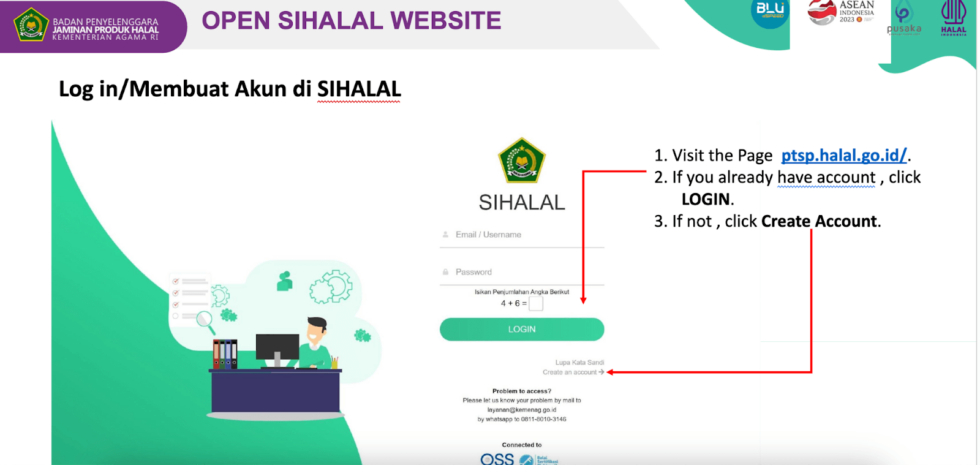
A foreign halal certificate from a BPJPH-recognized halal certification body generally must be registered in Indonesia before the covered products are distributed.
The Indonesian importer or official representative usually submits the foreign halal certificate registration, commonly known as SHLN registration, through the SIHALAL system.
The following steps reflect the SIHALAL foreign-certificate registration workflow available at the time of publication. Applicants should confirm the latest portal fields and BPJPH instructions before submission.
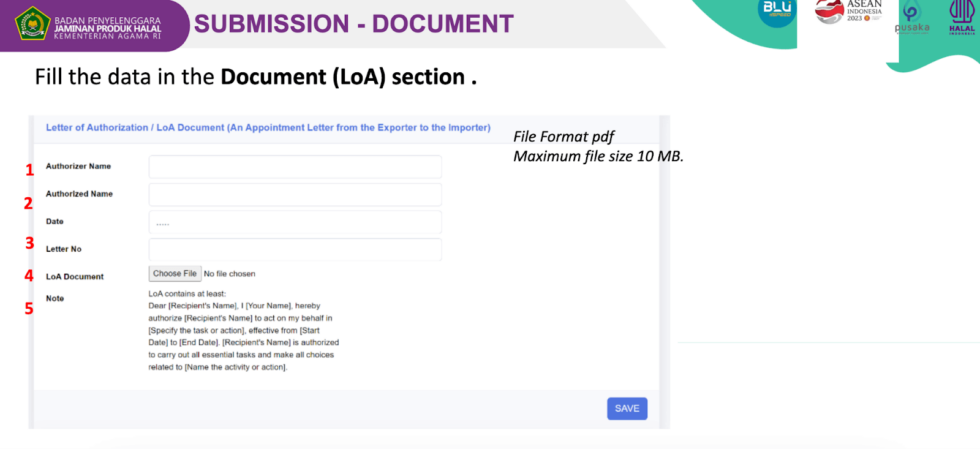
The file commonly includes:
- SHLN application letter
- Letter of Authorization
- Indonesian importer’s NIB
- Foreign halal certificate
- Apostille or legalization of documents where applicable
- Product list
- Eight-digit HS codes
- Statement confirming document accuracy
- Certified translations where required
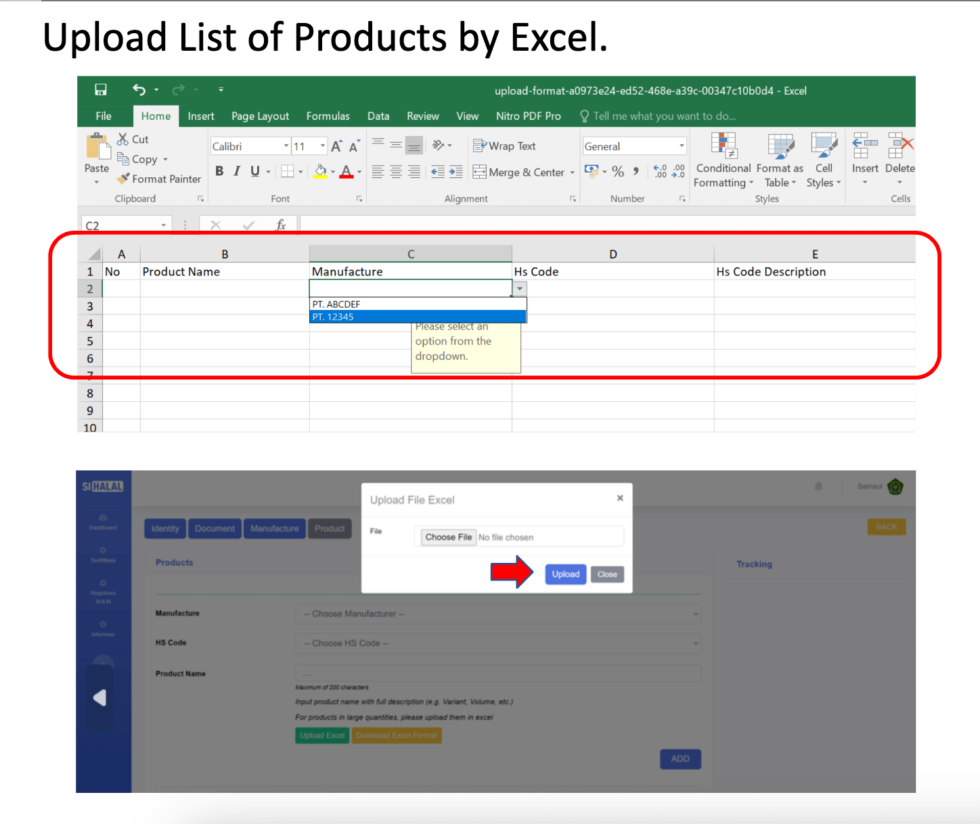
The product list may be entered directly or uploaded through the SIHALAL Excel format. The factory selected in the portal should match the manufacturing location covered by the halal certificate.
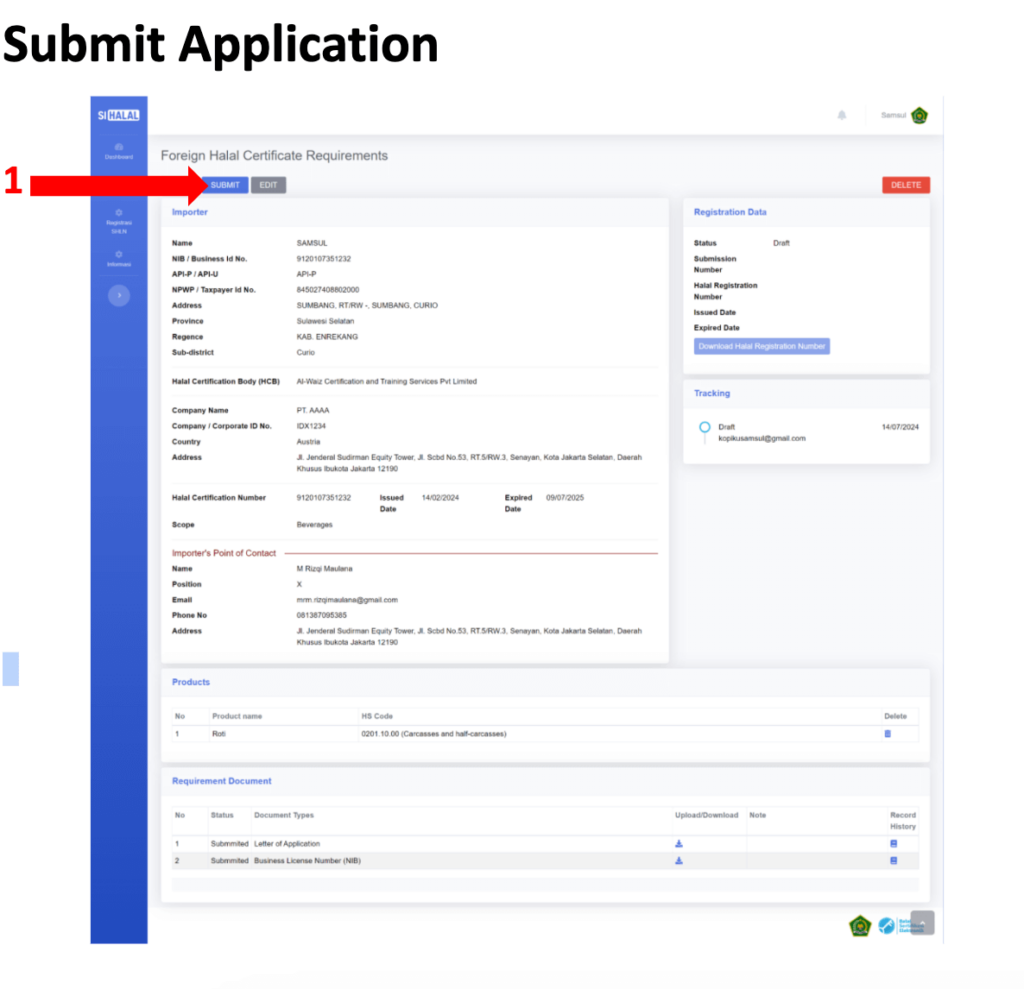
After submission, the application may show as Submitted, Returned, or Verified. If returned, the importer should review the tracking notes, correct the affected records, save the changes, and resubmit.
Read More: Indonesia Product Registration Guide with SIHALAL Screenshots and Checklists
Step 8: Finalize Labeling and Import Documentation
Approval does not automatically make a shipment ready for customs.
Before export, confirm that the final artwork includes the applicable:
- BPOM or category-specific registration number
- Bahasa Indonesia information
- Indonesian importer or authorization-holder details
- Ingredient list
- Warnings and directions
- Net content
- Batch and expiry details
- Halal label, where applicable
- Foreign halal certificate registration number near the halal label, where required
The importer may also need shipment-level import clearance before goods arrive. For regulated products, this can include a BPOM import certificate or SKI.
Commercial invoices, packing lists, certificates of origin, bills of lading, product names, HS codes, registration numbers, and shipment quantities should all match.
Step 9: Maintain Compliance After Approval
Indonesian product registration does not end once the product receives approval.
The Indonesian holder and U.S. manufacturer should maintain:
- Current supplier documents
- Batch and distribution traceability
- Complaint records
- Recall procedures
- Adverse-event reporting where applicable
- Updated formulas and specifications
- Certificate renewal dates
- Change-control records
- Label and claims review records
A change in formula, manufacturer, supplier, label, product name, packaging, or production site may require notification, amendment, or a new application.
Foreign halal certificate registration should also be renewed before the underlying certificate expires. Ingredient and process changes should be reviewed for their effect on halal status before implementation.
U.S. Exporter Readiness Checklist
Before scheduling the first shipment, confirm that you have:
- Classified the product correctly
- Confirmed the HS code
- Appointed an eligible Indonesian entity
- Agreed who controls the registration
- Prepared a consistent technical dossier
- Reviewed restricted ingredients and claims
- Secured the applicable BPOM or ministry approval
- Completed halal certification where required
- Registered the foreign halal certificate through SIHALAL, where required
- Finalized Bahasa Indonesia labeling
- Confirmed shipment-level import clearance
- Established post-market and change-control procedures
Summary
U.S. companies entering Indonesia should treat product registration and halal compliance as connected but separate workstreams.
The process begins with accurate classification and a qualified Indonesian partner. It then moves through dossier preparation, category-specific authorization, halal certification, foreign certificate registration, labeling, import clearance, and post-market compliance.
The October 2026 phase makes halal certification mandatory for food & beverages, cosmetics & personal care, supplements, chemicals, and other consumer goods.
AHF supports U.S. manufacturers seeking halal certification and Indonesia export readiness. Obtain a quote to review your product scope, ingredients, manufacturing facility, and BPJPH recognition requirements.
Frequently Asked Questions (FAQs)
Q1: Can a U.S. company register a product directly in Indonesia?
Most regulated products require an eligible Indonesian importer, subsidiary, distributor, or notification holder to complete local registration.
The U.S. company should use a clear authorization agreement that defines registration control, maintenance, renewal, transfer rights, and regulatory responsibility.
Q2: Does BPOM registration include halal certification?
No. BPOM market authorization and BPJPH halal compliance are separate requirements, even when both apply to the same product.
A company may need BPOM approval, halal certification from a recognized halal certification body, and SIHALAL registration of its foreign halal certificate.
Q3. What happens on October 17, 2026?
October 17, 2026, is a key milestone in Indonesia’s phased halal-certification framework, but it is not one universal product-registration deadline.
It is especially relevant for cosmetics, traditional medicines, health supplements, chemicals, certain consumer goods, and other covered categories. Some medicine and medical device categories follow later phases.
Q4. What is the difference between an ML number and an NA number?
An ML number is commonly used for imported processed food and beverage products registered with BPOM.
An NA number is issued through Indonesia’s cosmetic notification system and must appear on approved cosmetic product packaging.
Q5. Does an AHF certificate automatically complete Indonesian registration?
No. An AHF certificate may support the foreign halal certification requirement where AHF’s BPJPH recognition covers the relevant product scope.
The Indonesian importer or representative must still complete any required SIHALAL registration and separate product-registration steps before distribution.

Azmi Anees is a certification and compliance specialist working with the American Halal Foundation, where he focuses on global halal certification programs, integrated audits, and market-access strategy for food, cosmetic, nutraceutical, and ingredient manufacturers. He has worked closely with multinational brands and SMEs across North America, the Middle East, and Southeast Asia. His insights emphasize on practical guidance for manufacturers looking to achieve halal compliance while improving operational efficiency and global market reach.



 Food
Food Bread & Bakeries
 Beverages
 Coffee
 Confectionery Products
 Dairy & Cheese
 Food Service
 Food Enzymes
 Meat and Poultry
 Natural & Artificial Food Flavors
 Nuts & Dried Fruits